
Skip to content

New customers 10% off with WELCOME10.

Flat rate shipping on all indoor furniture

The Amish Dining Room Guide

A dining room gets used for everything. Meals, homework, paperwork, the four hours after Thanksgiving when nobody moves. This guide walks you through sizing the room, choosing the table, seating it and finishing it, in the order those decisions actually need to be made.

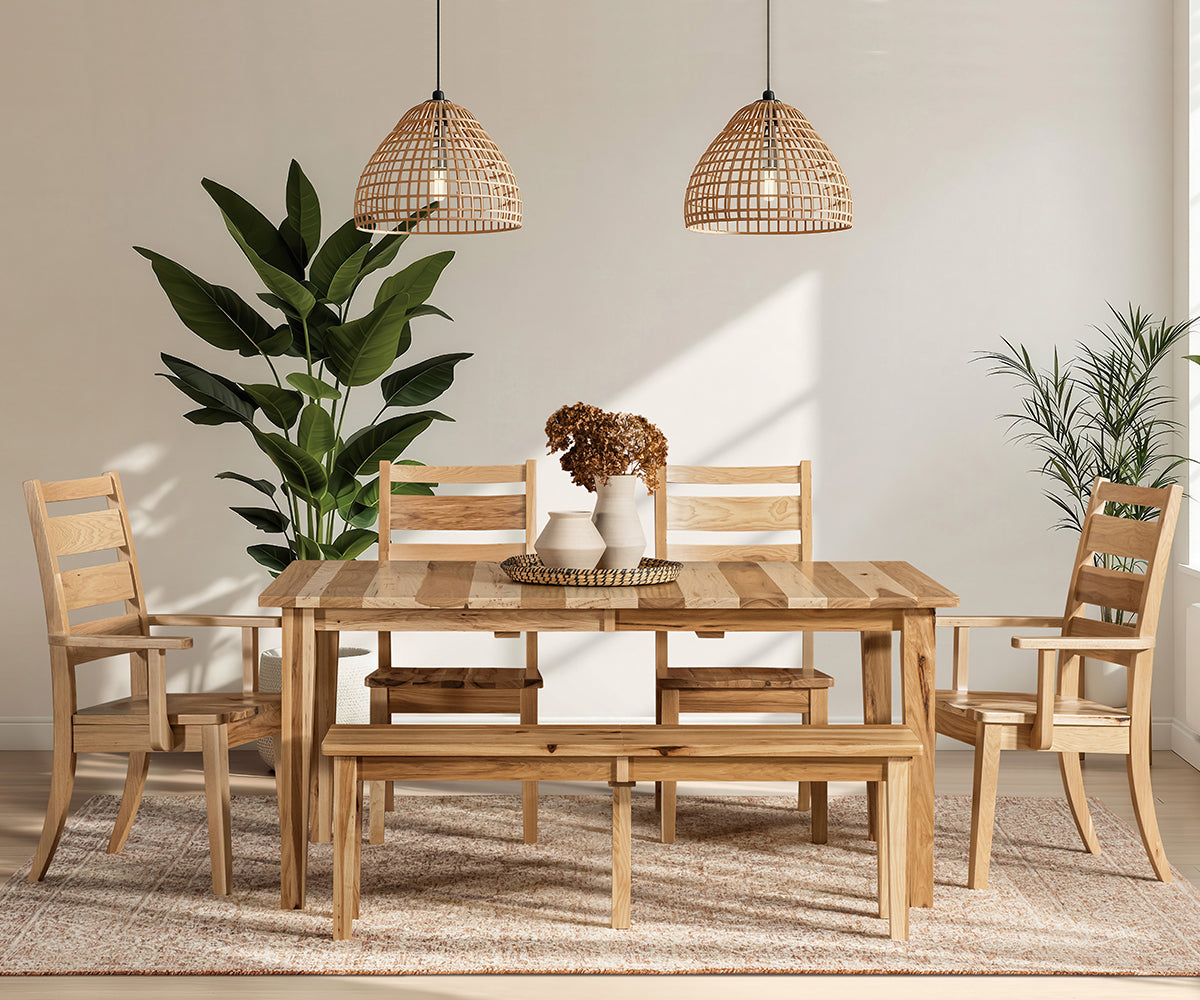
Amish Madison Trestle Table-Dining Table-The Amish House

How Much Space Does a Dining Table Need?

A dining table needs 24 inches of table edge for each person, 36 inches of clear floor behind every chair, and 48 inches on any side people walk along. Subtract those clearances from your room and whatever is left is the largest table the room can carry.
Most dining rooms get furnished the wrong way round. Someone falls for a table, checks the tabletop against the room, and finds out on delivery day that two chairs cannot be pushed back without hitting the wall. The table was never the constraint. The floor around it was.
Guide table
Measure Allow What it buys you
Table edge per person 24 inches A place setting and elbow room
Behind every chair 36 inches Enough to push back and stand
On any side people walk 48 inches Room to pass behind someone seated

Measure the doorways while the tape is out. A solid hardwood top is heavy and it does not flex, and the turn at the top of a staircase catches people out far more often than the front door.

What Does a Full Dining Room Need?

A full dining room is built from three groups of furniture: the table, the seating and the storage. They get decided in that order.
The table sets the size and the shape of everything after it. The seating follows, because the base of the table determines where people can sit and how many will fit. Storage comes last, since what you need from it depends on how much the table and chairs have already taken out of the room.

See the Finish Before You Commit

Stain reads differently on every wood, and it reads differently again under your own lights. Order the chips before you order the table.

How Big Should Your Dining Table Be?

A 42 inch wide top suits most dining rooms, and length is set by how many people sit down on an ordinary weeknight rather than at Thanksgiving. Leaves cover the difference.
A table that seats ten every day is a table you edge around for the 360 days nobody is visiting. Sizing for the everyday number and extending for the holidays is the single decision that saves most dining rooms.

Width

A 42 inch top is the standard. It leaves room for a bowl or a runner down the middle without crowding the place settings.

A 48 inch top carries serving dishes down the centre while people are still eating, which matters if you serve family style.

Past 48 inches a table starts to feel like a reach across.

Length

Length follows the 24 inch rule. Three seats fit along one side of a 72 inch top and two along a 60 inch, and a chair at each end gives you the total.

Guide table
Table size Seats day to day With two 12 inch leaves
42" x 42" 4 6
42" x 54" 6 8
42" x 60" 6 8
42" x 72" 8 10
42" x 84" 8 comfortably 10 to 12
42" x 96" 10 12

Pick the row that matches your everyday number, then let the leaves cover the holidays.

Leaves

Separate leaves are stored away from the table and added one at a time in 12 inch increments. They suit anyone who wants to size the table to the occasion.

A butterfly leaf folds and lives inside the table, in 12 or 18 inch depths depending on the model. Nothing has to be found in the attic on Christmas Eve.

A solid top has no extension at all, which is the right call when the room carries the full length permanently and you want one unbroken plank surface.

The trade-off with leaves is the seam. Every extension table has one. On a rustic or rough sawn top it disappears almost entirely, and on a smooth dark-stained top it is visible if you look for it.

Amish Parson Leg Table

Which Table Base Should You Choose?

Trestle, single pedestal and double pedestal bases leave the corners of the table clear, so chairs can sit anywhere along the sides. A leg table does not, which is the reason the person at the end of the table sometimes spends dinner with a table leg between their knees.
The four bases below are ordered by how much floor they leave free.
Amish Sunset Hills Trestle Table

Trestle

A trestle table sits on two feet joined by a horizontal stretcher, with nothing at the corners.
It suits wide plank tops and flexible seating, because chairs slide anywhere along the sides and you can squeeze an extra person in. This is the base most people picture when they picture a farmhouse table.
The limit is the stretcher. It runs low between the feet and some people find it in the way, particularly children who like to hook their heels on things.
Browse trestle tables
Amish Liam Single Pedestal Table

Single Pedestal

A single pedestal table stands on one central column with no legs anywhere.
It suits round and square tops and small rooms, because there is nothing to walk into and nothing dictating where the chairs go. A round top in a tight room is often the difference between a dining room and a corridor with a table in it.
The limit is length. Once the top grows, the weight sits too far from the centre and the table wants a second column.
Browse pedestal tables
Amish Larue Double Pedestal Table-Dining Table-The Amish House

Double Pedestal

A double pedestal table stands on two columns set in from the ends.
It suits long tables that still need to seat someone at each end in comfort, and it takes leaves well, including butterfly leaves that fold away inside the table.
The limit is room size. A double pedestal is a long table by definition, so it needs the floor space the clearances above describe.
Amish Wilmington Leg Table

Leg Table

A leg table has a leg at each corner joined by an apron under the top.
It suits formal dining rooms and smaller spaces, because it reads lighter than a heavy trestle base while staying the most traditional of the four.
The limit is where chairs can go. Corner legs restrict seating positions, and the apron can catch the arms of an arm chair, so check the clearance if you plan on arm chairs at the ends.
Browse leg tables

Send Us Your Room Dimensions

Not sure which base your room wants? Send us the room dimensions and we will tell you what fits and what will not.

Amish Bent Creek Single Pedestal Table

How Should You Seat the Room?

Most dining rooms are best seated with side chairs along the length, an arm chair at each end, and a bench on the side that gets used least. The right mix depends on who sits down and how long they stay.
Seating is where a dining room budget quietly goes, because you buy the table once and the chairs six or eight times. It is also where most of the comfort lives
Amish Kenton Chair-Dining Chair-The Amish House

Side Chairs and Arm Chairs

A side chair has no arms and an arm chair does. The conventional arrangement puts side chairs along the length and an arm chair at each end.
It suits anyone who wants the two people at the ends to have a little more room, and it signals where the hosts sit. Our Theodore chair comes both ways in the same design, so the set still reads as one set.
The limit is the apron. Arm chairs need the arms to clear the underside of the table, and on a leg table with a deep apron they sometimes will not.

A Bench

A dining bench is backless seating that pushes fully under the table when it is not in use.
It suits small rooms and families with children, because it gives the floor back and three eight-year-olds fit where two chairs would have gone. Visually it lightens the room, since a bench is one horizontal line rather than three chair backs.
The limit is comfort and access. There is no back support, and the person in the middle has to ask two people to move before they can leave the table.
Browse benches
Amish Liam Single Pedestal Table

Seat Material

Dining chair seats come in wood, leather or fabric. Our Theodore chair offers all three on the same frame.
A wood seat wipes clean, survives anything a child does to it, and never needs replacing. Leather sits between the two. Fabric is warmer and quieter in a room with hard floors, and it is the reason people stay at the table after dinner.
The limit is maintenance. If this is the everyday family table, wood or leather is the lower maintenance answer, and fabric earns its keep in a room used mainly for hosting.
Browse dining chairs

Counter and Bar Seating

Bar stools and bar chairs seat people at an island or peninsula rather than at the dining table.
They suit open plan rooms, and matching them to the dining chairs in wood and stain is what stops a kitchen and dining space reading as two rooms that happened to meet.
The limit is height. Bar height and counter height are different measurements and they are not close enough to fudge, so measure from the floor to the underside of the overhang before ordering.

What Storage Does a Dining Room Need?

Dining room storage comes in four forms: the sideboard or buffet, the hutch, the china cabinet and the coffee bar. They differ by height and by whether the job is serving, displaying or simply absorbing what the room uses.
Work out which of those three jobs is yours and the choice makes itself.

Sideboard and Buffet

A sideboard or buffet is a low, long cabinet with a usable surface on top.
It suits rooms with low ceilings or a wall you do not want to lose. It holds linens and serving pieces, and the top becomes your serving surface when you are feeding more people than the table can carry plates for.
The limit is display. A sideboard stores things rather than showing them, so china and glassware stay behind solid doors.
Browse buffets and sideboards

Hutch

A hutch is a buffet with an upper cabinet on it, usually glazed.
It suits anyone who wants storage below and display above, which is why it is the traditional home for china and glassware.
The limit is scale. A hutch is tall and it will dominate a small dining room, so if the ceiling is under eight feet or the wall is short, a sideboard gives you the same storage without the room shrinking around it.
Browse hutches

China Cabinet

A china cabinet is shallower and more glass than a hutch, designed to be looked into rather than worked from.
It suits rooms where the dining set is the furniture and the storage is there to display. Small china cabinets exist for exactly this reason, and a narrow one will fit a wall that a full hutch never would.
The limit is capacity. Less depth means less storage, so a china cabinet does not replace a buffet for linens and platters.

Coffee Bar

A coffee bar is a dedicated station for the machine, the grinder, the cups and the tins.
It suits open plan homes where the kitchen counter has run out of room, and it is the piece that gets used every single morning, which is not true of a china cabinet.
The limit is that it does one job. A coffee bar is not general dining storage, so it sits alongside a sideboard rather than instead of one.

Which Style Should You Choose?

Style can safely be decided last, because every style below is available in the same woods and the same stains. What changes is the line of the leg, the shape of the chair back and how much ornament sits on the piece.

The six below are the filters that run across our whole dining range, so picking one narrows 1,340 pieces to a manageable set.
Mission

Mission

Straight lines, exposed joinery, vertical slats. Honest construction left visible rather than dressed up.
Shaker

Shaker

Tapered legs, flat panels, no ornament at all. The quietest of the six and the easiest to live with over decades.
Farmhouse

Farmhouse

Wide plank tops, chunky trestle bases, often in a rougher grade of wood where the knots are part of the point.
Traditional

Traditional

Turned legs, shaped aprons, raised panels. The most formal of the six and the one that suits a separate dining room best.
Transitional

Transitional

Traditional proportions with the ornament stripped back. The safe answer when the rest of the house is not committed to one direction.
Contemporary

Contemporary

Clean lines, minimal profiles, often lighter stains and a thinner tabletop edge.
Amish Venhaus Leg Table

How Do You Choose the Wood and the Stain?

Choose the species first and the stain second, then order a physical sample in that species before you commit. The same stain produces visibly different results on different woods, which is why a stain name on its own tells you very little.
A dining table is the largest single surface of wood most people will ever own. The stain that looked right on a screen at eleven at night is frequently not the stain that looks right on the floor in daylight.

Species Sets the Grain, Stain Sets the Colour

The species decides the grain, the hardness and the underlying colour. The stain sits on top of that.

Open-grained woods like oak drink the colour into the grain. Closed-grained woods like maple hold it more evenly on the surface.
The same stain on oak and on maple produces two visibly different tables.

Solid Wood Moves With the Seasons

Wood is hygroscopic, meaning it takes up and gives off moisture as the humidity in a room changes. The USDA Forest Service Wood Handbook puts the moisture content of wood in a heated interior at around 6 to 8 percent across most of the United States.
In practice, a solid hardwood table expands a little in a humid summer and contracts in a dry winter.
Keep it off the wall directly above a floor vent and away from a radiator, and that seasonal movement stays invisible.
ORDER STAIN SAMPLES

The Same Wood and Stain, in the Next Room

If you are working on the kitchen at the same time, our sister company builds custom cabinetry from the same hardwoods and the same finishes, so the cabinets and the dining table can be specified as one decision rather than two.

Amish Fulton Trestle Table-Dining Table-The Amish House

What Does It Cost and How Long Does It Take?

Amish dining tables start around $1,800 and run past $5,900, and dining chairs start around $400 each. Most pieces are built to order and arrive in 8 to 12 weeks, with delivery and in-home setup at a flat $239.

Solid hardwood costs more than the alternative and there is no useful way around saying so. What is worth explaining is where the money goes.

What Happens After You Order

Guide table
Lead time Most dining pieces are built to order and arrive in 8 to 12 weeks, depending on which workshop is building yours
Quick Ship Selected pieces and configurations ship in 3 to 5 weeks, plus two more weeks for delivery
Delivery Flat $239 across the lower 48, with in-home setup. Alaska and Hawaii excluded
Warranty One year against defects in materials and workmanship
Financing Available at checkout on eligible orders

Lead time is the thing to plan backwards from. If the table needs to be in place for Thanksgiving, an order placed in August is comfortable and an order placed in October is not.

Work Through It in This Order

Measure the floor before you look at tabletops. Settle the width, then the length, then whether you want leaves. Choose the base by where people need to sit. Then pick the species, order the chips, and leave the style decision until last, because it does not constrain anything else.

If you would rather not guess, call us at 615-819-2772 with the dimensions of your room and how many people you seat, and we will tell you what fits and what will not.

You can also browse the full range of Amish dining furniture at your own pace, or come and sit at the tables at our showroom on Nolensville Road. We are open Tuesday through Saturday, 10 am to 5 pm.

Frequently Asked Questions

Yes, and people do it regularly to spread the cost. Tell us at the time of the table order which chair and stain you intend to come back for, and we will note the exact specification so the later order matches rather than nearly matches.
Often, depending on the workshop building it. The listed sizes are the standard runs, and custom dimensions are frequently possible within limits. Call us with the size you need and we will confirm before you order.
No. Different workshops build different parts of our range, so a chair may offer seven species while a bench offers one. If you are matching pieces across a set, check the combination with us first and we will tell you what can be built together.
No. Open-grained woods like oak take colour into the grain while closed-grained woods like maple hold it on the surface, so the same stain name produces two different results. Order the chip in your species.
Yes. Leaves are cut from the same boards and finished in the same batch as the table, which is why they are specified at the time of order rather than added afterwards.
Wipe spills rather than letting them sit, use mats under anything hot, and keep the table away from a direct heat source. No oiling, waxing or refinishing schedule is required.
Sometimes closely, rarely exactly. Send a photograph and, if you can, a small piece or a drawer front, and we will work through the samples with you to find the nearest stain on the species you are ordering.
For a built-to-order table arriving before Thanksgiving, order by August. Quick Ship pieces need roughly five to seven weeks all in, which makes late September the realistic cut-off for those.