
Skip to content

New customers 10% off with WELCOME10.

Flat rate shipping on all indoor furniture

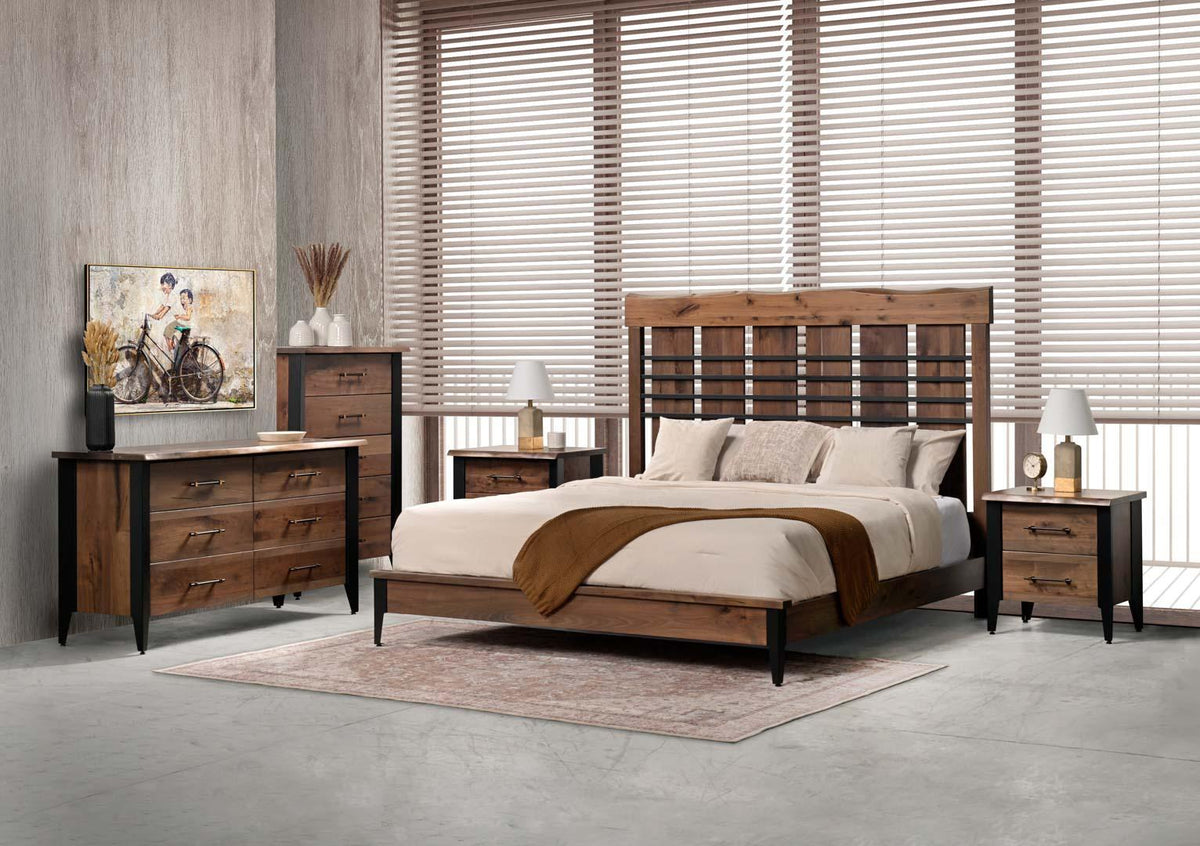
Amish Uptown Two Drawer Nightstand-Nightstand-The Amish House

The Solid Wood Bedroom Furniture Guide

A bedroom is the one room nobody else sees and the one you wake up in every day. It gets furnished last, with whatever is left of the budget, and then you live in it longer than anything else in the house. This bedroom furniture guide covers sizing the bed, choosing the frame, adding storage and settling the finish, in that order, so the space that starts and ends your day isn’t an afterthought.

How Much Room Does a Bed Actually Need?

A bed needs 30 inches of clear floor on every side people get in and out from, 36 inches at the foot if there is a walkway, and 36 inches in front of any dresser so the drawers open fully. Add those to the mattress footprint and you have the smallest room the bed can honestly sit in.

The mistake is treating the mattress dimensions as the answer. A queen is 60 inches wide, so a 10 foot wall sounds generous until the frame adds a few inches on each side, the nightstands take 20 more, and the door swings into what is left. Rooms fail at the edges rather than in the middle.
Guide table
Measure Allow What it buys you
Each side you get in from 30 inches Room to make the bed without climbing on it
The foot of the bed 36 inches A walkway rather than a squeeze
In front of a dresser 36 inches Drawers that open all the way

Measure the route in before you measure the room. A solid hardwood headboard does not flex and a king headboard is a single piece, so the stairwell turn decides more bedroom purchases than most people expect.

What Does a Full Bedroom Need?

A full bedroom is built from three groups: the bed, the storage and the mattress. The bed gets decided first because it sets the footprint, and the mattress gets decided last because it is the one piece that does not have to match anything.

Storage sits in the middle, and it is the part people underestimate. A bedroom that runs out of drawers ends up with clothes on a chair, which is the single most common reason a finished room still feels unfinished.

Judge the Stain by Lamplight

A bedroom is lit by two bedside lamps for most of the hours you are in it, and warm light pulls every stain darker than it looks on a screen. Order the chips and leave them on the nightstand overnight.

Which Bed Size Should You Choose?

Queen is the right answer for most main bedrooms, king for couples who want the width and have the wall to give it, and full for a room that has to do a second job. The size is decided by the room rather than by preference, because clearance is not negotiable.

Size up only if the room can still hold the clearances above. A king in a room that cannot take one turns the bedroom into a bed with paths around it.
Guide table
Size Mattress footprint Suits
Twin 38" x 75"
Children's rooms, bunk beds, narrow guest rooms
Twin XL
38" x 80" Taller single sleepers, split king setups
Full 53" x 75"

One adult with room to move, or a room doubling as an office
Full XL 53" x 80" The same width with five more inches of length
Queen 60" x 80" Two adults in a standard main bedroom
King 76" x 80" Two adults who want the width, or who share with children
California King 72" x 84" Sleepers over roughly six feet who need length more than width

Two sizes get mismeasured more than the rest. Full XL and California King both differ from their better-known siblings in length rather than width, so check the frame rather than the mattress you are replacing.

Headboard Height

Headboard height decides how the bed reads in the room. A tall headboard anchors a room with high ceilings and fills a long blank wall, which is why it suits a main bedroom with nothing else on that side.

Our Yellowstone bed is offered at 76 inches and at 59 inches in the same design, so the choice is a specification rather than a different bed.

The limit is the wall. A tall headboard under a window or a sloped ceiling fights the architecture, and a lower one is the better call in a room with either.

Footboard Height

A standard footboard closes the bed visually and gives the frame a finished outline. A low footboard opens the end of the room and makes a small bedroom read longer than it is.

Several of our beds offer both. The Celina comes with a standard footboard at 21 inches or a low one at 14.25 inches, and the difference in how the room feels is larger than the seven inches suggests.

The limit is bedding. A low footboard shows more of the foot of the mattress, so the duvet has to be long enough to cover it properly.

Which Bed Frame Is Right for Your Room?

Choose the frame by what the room is short of. A platform bed saves height, a storage bed saves drawers, a bookcase bed saves a nightstand, and a sleigh bed saves nothing at all but looks like nothing else.

The four below are ordered from the least visual weight to the most.
Amish Hudson Urbanna Platform Bed

Platform Bed

A platform bed carries the mattress on a built-in slat or solid deck, with no boxspring underneath.

It suits low ceilings, small rooms and anyone who finds a tall bed hard to get in and out of, because losing the boxspring drops the sleeping surface by several inches. It also costs less overall, since the boxspring comes out of the order entirely.

The limit is underbed space. A platform bed sits closer to the floor, so the storage you were using down there mostly disappears.
Browse platform beds

Storage Bed

A storage bed builds drawers into the base of the frame, usually two or four along the sides.

It suits rooms with no closet worth the name, and it is the single most effective fix for a bedroom short on storage. Drawers in the bed base hold what would otherwise need a second chest that the room has no wall for.

The limit is access. Side drawers need clear floor to open into, which is the same 30 inches the clearances above already ask for, so a storage bed rules out pushing one side against a wall.
Browse storage beds
Amish Book Case Head Board 12" Deep 52.50" Tall

Bookcase Bed

A bookcase bed puts shelving into the headboard, sometimes with sliding doors or a light.

It suits guest rooms, children's rooms and any bed that cannot have nightstands beside it, because the headboard does the nightstand's job. In a narrow room that is often the difference between a bed that fits and one that does not.

The limit is depth. A bookcase headboard adds roughly a foot to the length of the bed, so measure the wall against the whole frame rather than the mattress.
Browse bookcase beds
Amish Louis Phillip Sleigh Bed with Sleigh Foot-Bed-The Amish House

Sleigh Bed

A sleigh bed has a curved, scrolled headboard and footboard, shaped rather than flat.

It suits larger main bedrooms and traditional interiors, and it is the frame that carries a room on its own when there is nothing else in it. The curve is where the joinery shows, which is why it tends to be the piece people point at.

The limit is footprint. The scroll extends the bed beyond the mattress at both ends, so a sleigh bed occupies more floor than its size suggests.
Browse sleigh beds

Send Us Your Room and Stairwell

Tell us the room dimensions, the ceiling height and the turn at the top of your stairs, and we will tell you which beds fit and which will not come up.

Amish Cambridge 56" Dresser

How Should You Store Clothes in a Bedroom?

Most bedrooms want a dresser for folded clothes, a pair of nightstands for what you use at night, and either a chest or an armoire depending on whether the room is short on floor space or short on wall space. The choice is decided by geometry rather than by taste.

Height is also a safety decision. The Consumer Product Safety Commission's Safety Standard for Clothing Storage Units applies to every clothing storage unit and exists to protect children up to 72 months old from tip-over injury. Anchor anything tall to the wall, and treat that as part of the purchase rather than an afterthought.
Amish Contour 56" Six Drawer Dresser

Dresser

A dresser is wide and low, with drawers side by side across its width.

It suits rooms with a free wall and works as the surface a mirror hangs over or sits on. Several of ours, including the Siesta Mission and the Arlington, are offered as dresser only or dresser with a matching mirror.

The limit is wall length. A dresser needs a run of clear wall that a bedroom with two doors and a window often does not have.
Browse dressers
Amish Contour Four Drawer Chest

Chest

A chest is tall and narrow, stacking the same drawer capacity vertically instead of horizontally.

It suits rooms short on wall space, and it is the piece that rescues a bedroom where the dresser will not fit. Two people sharing a room frequently end up with one dresser and one chest rather than two of either.

The limit is the top drawer and the tipping risk. A tall chest puts its highest drawer above eye level for shorter adults, and it is exactly the shape the anchoring standard above was written for.
Browse chests
Amish Cambridge One Drawer Open Nightstand

Nightstand

A nightstand holds what you reach for without getting up, which in practice is a lamp, a book, a glass of water and a charger.

It suits every bed that has room for one, and the number of drawers is the only real decision. A single drawer keeps the piece light beside a low bed, while three drawers turn it into genuine storage in a room that needs it.

The limit is height. A nightstand much lower than the top of the mattress means reaching down for the lamp in the dark, so match it to the bed rather than to the other furniture.
Browse nightstands
Amish Farmhouse Four Drawer Armoire-Armoire-The Amish House

Armoire and Chifforobe

An armoire is a tall cabinet with doors, and a chifforobe combines hanging space on one side with drawers on the other.

It suits older houses with shallow closets or none at all, and it handles hanging clothes that a dresser cannot take. It is also the piece that hides a television in a bedroom where nobody wants to look at one.

The limit is ceiling height and delivery. An armoire is the tallest thing in most bedrooms, so check both the ceiling and the stairwell before ordering.
Browse armoires
Perfect Choice Two-Sided Memory Foam Mattress-The Amish House

What Should You Put the Mattress On?

The mattress is the one bedroom decision that is about your body rather than your room, and it is the piece most people choose last and regret first. Start from how you sleep, then check that the build works with the frame you have chosen.

Two-sided and single-sided is the first fork, and it changes how the mattress ages rather than how it feels on night one.

Two-Sided

A two-sided mattress is upholstered on both faces, so either side can be slept on.

It suits anyone buying furniture they expect to keep, because turning it moves the wear onto a surface that has been resting. Body impressions still form, more slowly, which across the life of the bed is the difference that shows.

The limit is weight and effort. Turning a queen or larger is a two-person job, and the advantage only materializes if it actually happens twice a year.
Royal Night Plush Single Sided Mattress-The Amish House

Single-Sided and Adjustable

A single-sided mattress is finished on one face only, and it is the build designed to work with an adjustable base.

It suits anyone who raises the head of the bed to read, to sleep, or on medical advice, because these mattresses are engineered to bend in one direction.

The limit is that the decision is permanent. A single-sided mattress cannot be turned, so the firmness you choose is the firmness you keep.
Ultrapedic Foam Two-Sided Mattress-The Amish House

Memory Foam and Latex

Foam builds contour to the body instead of pushing back, which is what side sleepers are usually looking for when they say a mattress is too hard.

They suit shoulders and hips, the two narrow points that carry the weight on your side, and they transfer almost no movement across the bed.

The limit is temperature and response. Foam runs warmer than an innerspring and takes a moment to release when you change position.

What Sits Underneath

Every size comes four ways: as a set with a matching boxspring, as a mattress only, as a boxspring only, or with a split boxspring.

The split option exists for a practical reason, which is that a one-piece boxspring is rigid and frequently will not make the turn at the top of a staircase.

The limit is what you already own. A tired boxspring pulls a new mattress down into the hollow it has already formed, so if yours has started to dip, order the set rather than the mattress alone.

Which Bedroom Style Should You Choose?

Style is the safest decision on this page to leave until last, because every style below is built in the same woods and finished in the same stains. What changes is the profile of the headboard, the hardware on the drawers and how much the piece announces itself.

A bedroom also takes style differently from the rest of the house. It is the room you see first thing in the morning and last thing at night, which is an argument for the quieter end of this list.
Amish Maison Bed-Bed-The Amish House

How Do You Choose a Set That Works Together?

Choose the wood and the stain once, apply them across every piece, and let the shapes vary from there. A bedroom reads as a set because the material matches, not because the furniture is identical.

This is the decision people get backwards. They hunt for pieces from one named collection and end up with a room where the nightstand, the chest and the bed all repeat the same detail four times over.

Match the Material, Not the Silhouette

Species and stain are what unify a bedroom. Everything else can differ without the room looking accidental.

A panel bed with a tall chest and a pair of low three-drawer nightstands works perfectly well, provided all four are the same wood in the same finish. Varying the heights is what stops a set looking like a showroom display.

The limit is how far you push it. One shared species and one shared stain is the rule holding the room together, so the moment those diverge, the variation reads as a mistake rather than a choice.

Choose the Options Before You Order, Not After

Most of what makes a piece yours is specified at the time of order and cannot be added later.

That covers the species and stain, the size, the headboard and footboard heights, whether a dresser arrives with its matching mirror, and how many drawers a nightstand carries. Our Yellowstone bed is offered at two headboard heights and the Celina at two footboard heights, so those are specifications rather than separate products.

The limit is that the list is fixed once the order is placed. A workshop builds to the specification it receives, so changing your mind at week six means starting the lead time again.

Decide What You Are Buying Now and What Waits

A bedroom is rarely bought in one go, and staging it is sensible as long as you stage it deliberately.

Buy the bed and the mattress first, since those are the pieces the room cannot function without. Nightstands come next because they are the smallest spend that makes the room feel finished. Storage can wait, and it is usually the piece the room turns out to need a different size of anyway.

The limit is matching. Pieces ordered months apart are built from different boards and finished in different batches, so the match is close rather than exact, and ordering together is always the better result.

Order chips for every species on your list before anything is placed. A bed and a nightstand are not always offered in the same wood, and the same stain behaves differently on oak than it does on brown maple, so the samples are how you find out whether the pair you want still reads as a pair.
ORDER STAIN SAMPLES

american made amish breckenridge collection

What Does It Cost and How Long Does It Take?

Solid hardwood beds start around $1,100, dressers, chests and nightstands from around $500, and mattresses from around $860. Most pieces are built to order and arrive in 8 to 12 weeks, with delivery and in-home setup at a flat $239 however many pieces are on the order.

That last point matters more in a bedroom than anywhere else, because a bedroom is bought as a group. Delivery on a bed, a dresser, two nightstands and a mattress costs the same as delivery on a single chair.
Guide table
Lead time Most bedroom pieces are built to order and arrive in 8 to 12 weeks, depending on which workshop is building yours
Quick Ship Selected pieces and configurations ship in 3 to 5 weeks, plus two more weeks for delivery
Delivery Flat $239 across the lower 48, with in-home setup. Alaska and Hawaii excluded
Warranty One year against defects in materials and workmanship
Financing Available at checkout on eligible orders

Order the whole set at once if you can. Pieces from different workshops run on different schedules, so a set ordered in one go arrives together, while a nightstand added three weeks later can land two months behind the bed.

Work Through It in This Order

Measure the room and the stairwell first. Settle the bed size against the clearances rather than against the mattress you have now, then choose the frame by what the room is short of. Add the storage that fits the wall you have left, pick the species, and leave the style until last.

If you would rather not guess, call us at 615-819-2772 with the room dimensions and the pieces you have in mind, and we will tell you what fits and what can be built together.

You can also browse the full range of Amish bedroom furniture at your own pace, or come and see the beds in person at our showroom on Nolensville Road. We are open Tuesday through Saturday, 10 am to 5 pm.

Frequently Asked Questions

It depends on the frame. Platform beds are built to carry the mattress directly, while other designs are made around a boxspring or a foundation. Tell us which bed you are looking at and we will confirm what it needs before you order the mattress.
Usually, because the frame comes apart. The piece to check is the headboard, which arrives whole and does not flex. Measure the narrowest point of the turn at the top of your stairs and send us the number if you are unsure.
Yes, and particularly with children in the house. Tall clothing storage is the shape most at risk of tipping, which is why there is a federal standard covering it. Anchor it when it is set up rather than planning to come back to it.
On many of them, yes. Pieces like the Siesta Mission and Arlington dressers are offered as dresser only or dresser with mirror, chosen as an option at the time of order rather than bought separately.
Closely rather than exactly. Wood varies within a species and pieces are sometimes built in different workshops, so two items in the same stain will be a close match with natural variation. Ordering the set together gives the best result.
Sometimes, depending on the frame and the mattress. Adjustable bases need a frame that can take one and a mattress built to bend in one direction. Call us with the bed you are considering and we will tell you whether the combination works.
Yes. We build bunk beds, and there is a full children's bedroom range in the same solid hardwoods and the same stains as the main collection, so a child's room can match the rest of the house.
Usually 8 to 12 weeks, but the set arrives on the slowest piece in it if the pieces come from different workshops. Ordering everything in one go is what keeps the delivery to a single date.